
27 Jul, 2026 | DBT Clinics Australia | No Comments
Telehealth and Mental Health: Therapy That Fits Into Real Life
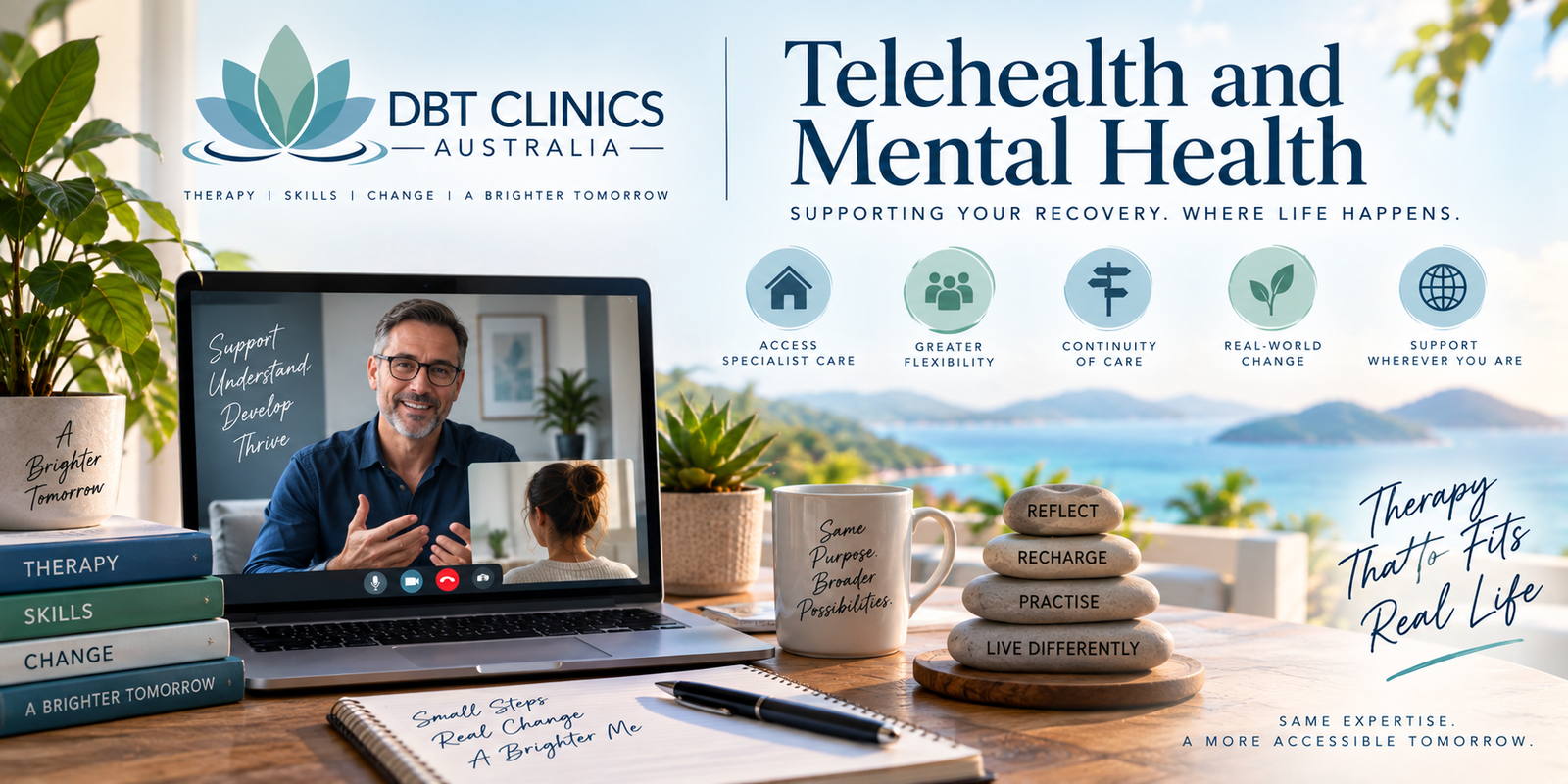
For many years, psychological therapy was closely associated with the consulting room. People travelled to a clinic, sat with their therapist for an appointment, and then returned to their everyday lives.
Technology has changed where therapy can take place, but more importantly, it has changed who can access specialist mental health care and how easily that care can be integrated into everyday life.
At DBT Clinics Australia, our clinical services are increasingly delivered through telehealth. This is not simply a matter of convenience or replacing an in-person appointment with a video call. We see online therapy as an important way of improving access, maintaining continuity and supporting people to practise psychological skills in the environments where they actually live.
Australian telehealth services have now become an established part of healthcare. The Australian Government notes that expanded telehealth became an ongoing part of Medicare in 2022 and describes it as important for continuity and access to care.
Therapy Doesn’t Have to Happen in a Consulting Room
One of the assumptions about psychological therapy has traditionally been that the clinician and client need to be physically together for meaningful therapeutic work to occur.
For many people, face-to-face therapy remains valuable and may sometimes be clinically preferable.
But being in the same room is not what makes therapy therapeutic.
Effective therapy depends upon factors such as a strong working relationship, clear treatment goals, appropriate evidence-based interventions, active participation and the ability to take what is learned in therapy and apply it to everyday life.
Research increasingly supports the capacity to develop meaningful therapeutic relationships through online psychotherapy. The therapeutic alliance remains associated with treatment outcomes in teletherapy, just as it matters in face-to-face treatment.
Greater Access to Specialist Care
Perhaps the greatest benefit of telehealth is that where someone lives no longer needs to determine which therapist they can see.
Specialist mental health clinicians are not distributed evenly across Australia.
For someone living regionally, remotely or even in a metropolitan area without the right specialist nearby, accessing a clinician experienced in a particular treatment approach can involve considerable travel—or may previously have been impossible.
Online appointments can reduce that barrier.
At DBT Clinics Australia, this is particularly relevant because our work includes specialist approaches such as Dialectical Behaviour Therapy (DBT), Radically Open DBT (RO DBT), trauma-informed therapy and Stabilisation-Based Therapy.
Rather than asking: “Who is the closest therapist to me?”
telehealth can allow someone to ask: “Who is the right therapist for what I need?”
That is an important change.
Continuity Matters in Mental Health Recovery
Mental health recovery rarely follows a perfectly predictable path.
People move.
They travel.
Work circumstances change.
Family responsibilities change.
A university student may relocate. Someone may need to spend time interstate or overseas. A person living regionally may have difficulty travelling during particular periods.
Historically, these changes could interrupt therapy or require someone to begin again with another clinician.
Telehealth can provide greater continuity.
The therapeutic relationship can travel with the person.
This is particularly valuable in therapies such as DBT and RO DBT, where treatment often involves learning and practising new behaviours over time rather than simply attending isolated appointments.
Continuity also matters because therapy is a relationship. Having to repeatedly explain your history and rebuild trust with new clinicians can itself become a barrier to treatment.
Bringing the Therapist Closer to Real Life
There is another advantage of online therapy that is discussed less often.
The client is often participating in therapy from the environment in which their life actually happens.
They may be sitting at home rather than in a clinician’s office.
This can create useful therapeutic opportunities.
A person might discuss difficulties establishing routines while sitting in the environment where those routines need to occur.
Someone learning emotional regulation strategies can consider where and how they will practise them at home.
A therapist may help someone identify environmental triggers or practical barriers that would never be visible in a consulting room.
The transition between “therapy” and “life” becomes smaller.
For behavioural therapies in particular, this can be valuable because ultimately the purpose of therapy is not to become better at therapy—it is to become better able to navigate life.
Less Travel, Less Disruption
Attending a one-hour face-to-face appointment can consume considerably more than one hour.
There may be travel in both directions, parking, waiting rooms, time away from work, arranging childcare or reorganising other responsibilities.
For some people, these practical barriers contribute to missed appointments or make regular therapy difficult to sustain.
With telehealth, a client may be able to attend from home, a private office or another appropriate location and then return to their day.
This can make ongoing treatment easier to integrate into work, study and family life.
It can also reduce some of the barriers experienced by people living with disability, mobility difficulties or limited access to transport.
More Choice and Greater Flexibility
Telehealth also gives people more choice.
Geographical proximity does not necessarily mean therapeutic compatibility.
The clinician five kilometres away may not have expertise in the difficulty someone is experiencing, while an appropriately trained clinician may be hundreds or thousands of kilometres away.
Online care expands the pool of clinicians a person may potentially access.
This is particularly important when seeking treatment for complex or less commonly treated presentations where specialist expertise may matter.
Can You Really Develop a Therapeutic Relationship Online?
This is one of the most understandable concerns about telehealth.
The therapeutic relationship matters enormously.
People need to feel heard, understood and able to work collaboratively with their clinician.
Research suggests that meaningful therapeutic alliances can be established through videoconferencing and other forms of online psychological treatment. Reviews have found therapeutic alliance remains relevant to outcomes in online psychotherapy, although researchers continue to investigate ways in which alliance may operate somewhat differently online compared with face-to-face treatment.
Technology therefore does not remove the human relationship from therapy.
A screen does not automatically create distance, just as sitting in the same room does not automatically create connection.
The quality of the therapeutic relationship continues to depend greatly upon how the therapist and client engage with one another.
Supporting Independence Rather Than Dependence
There can also be something therapeutically valuable about attending treatment from your own environment.
The therapist is not physically beside the person.
Instead, the clinician is helping the individual learn to observe, regulate, problem-solve and respond differently within their own world.
For some people, this can support an important shift:
from “I can manage this when my therapist is here”
toward
“I am learning how to manage this myself.”
Good therapy should progressively help people develop skills and confidence that exist independently of the therapist.
Telehealth can fit naturally with that philosophy.
Connecting Telehealth With Wise Mind Retreats
Our increasing use of telehealth at DBT Clinics Australia also complements our relationship with Wise Mind Retreats in Phuket, Thailand.
We do not necessarily see online therapy and intensive face-to-face experiences as alternatives.
They can work together.
Someone may undertake assessment and preparation online before attending a retreat in Phuket. During the retreat, there can be opportunities for more intensive experiential learning and real-world skills practice. After returning home, telehealth can reconnect the person with ongoing clinical support and help translate what was learned into everyday life.
We think of this as: Prepare → Learn → Experience → Practise → Return → Consolidate
This allows therapy to move with the person rather than being tied to one physical building.
Telehealth Is Not Right for Every Situation
Online therapy also has limitations.
Some people simply prefer being physically present with their clinician. Others may not have a sufficiently private or stable environment for online sessions. Technology can fail, and some clinical presentations or periods of acute risk may require local, face-to-face, medical, psychiatric or emergency support.
Good telehealth therefore requires more than opening a video link.
It requires appropriate assessment, privacy, clear communication, safety planning where required and consideration of whether online treatment is suitable for the individual.
Our aim is not to argue that telehealth is always better than face-to-face therapy.
Rather, the method of delivering therapy should serve the needs of the person—not the traditions of the service providing it.
A Different Way of Thinking About Mental Health Care
The growth of telehealth gives us an opportunity to reconsider what a mental health clinic actually is.
For much of our history, a clinic was a physical place.
Today, perhaps it is more useful to think of a clinic as a network of therapeutic relationships, specialist knowledge and services that can reach people wherever appropriate care can safely occur.
This thinking is increasingly shaping the future of DBT Clinics Australia.
Our clinical services have their foundations in the work provided through Essentia Health since 1999. Over more than 25 years, the way people communicate, learn and access healthcare has changed enormously.
Our services need to evolve as well.
The transition toward online treatment allows us to maintain our commitment to specialist mental health care while reaching people well beyond the geographical boundaries of a traditional consulting room.
For many clients, that means less travel, greater flexibility, improved continuity and better access to clinicians with the expertise they need.
Most importantly, it means therapy can increasingly happen closer to where recovery ultimately has to happen: in everyday life.
Dr Peter King
On behalf of the DBT Clinics Australia team
Clinical & Academic Lead
Asia Pacific DBT Institute
Write Reviews
Leave a Comment
Lorem ipsum dolor sit amet, consectetur adipiscing elit, sed do eiusmod tempor incididunt ut labore et dolore magna aliqua.
No Comments & Reviews